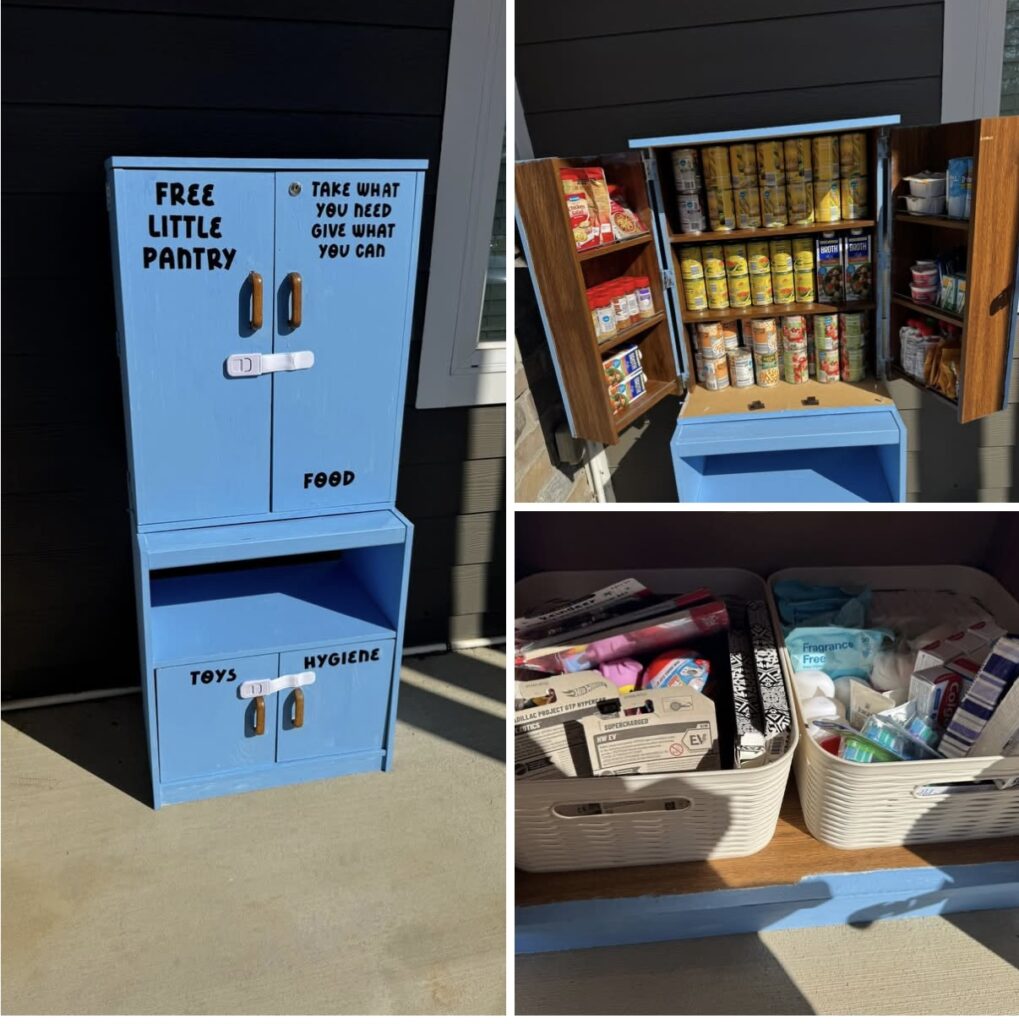

Across Maryville, Tennessee, local residents are talking about one small but powerful act of kindness that has captured the heart of the community: a Maryville community pantry handcrafted and installed by a local woman named Ellie Gratton. What began as a simple idea—“take what you need, give what you can”—has grown into a symbol of generosity, dignity, and neighbor-to-neighbor support.
A Grassroots Response to Local Need
The rising cost of living in East Tennessee has placed growing pressure on families. Food insecurity has quietly expanded across Blount County, with regional nonprofit reports estimating that 1 in 7 residents struggle to access fresh food consistently. While larger food banks and churches do critical work, many residents still fall through the cracks due to transportation barriers, work schedules, or stigma.
Ellie saw this firsthand in her community and decided not to wait for a large organization to step in. Instead, she built something small, bright blue, and full of heart—a free little pantry open to anyone. Installed in front of her apartment complex and stocked with food, hygiene products, toys, and household essentials, it reflects a simple yet transformational truth: even one person can help restore dignity to their neighbors.
Her Facebook post announcing the pantry quickly gained momentum, drawing over 1,000 reactions in just 48 hours. Dozens of comments from Maryville residents praised her for stepping up when the community needed it most.
“Take What You Need, Give What You Can”
In her original post, Ellie wrote:
“I truly hope this helps out our local community because everyone deserves nourishing their bodies.”
She emphasized that anyone is welcome, whether they need support or want to contribute. After launching a GoFundMe to help restock the shelves, donations poured in. Community members who couldn’t give money dropped off canned goods, pasta, hygiene products, and children’s items. Within a day, the pantry was completely full—then emptied—and then restocked again thanks to neighbors responding to Ellie’s call.
One commenter wrote,
“This is what Maryville is all about—neighbors helping neighbors.”
The pantry doesn’t just provide food. It offers something less tangible but deeply needed: a sense of belonging and mutual care.
A Model of Micro-Community Action
Little free pantries have begun appearing across the U.S., inspired by the Little Free Library movement. Studies from urban sociology programs show that these micro-pantries increase community connection, reduce food anxiety, and encourage residents to check on one another. They are particularly effective in suburban communities like Maryville, where public transportation is limited and residents are often far from traditional food banks.
Ellie’s pantry is a perfect example of how small, decentralized efforts fill gaps that large institutions cannot always reach.
Growing Support and Sustaining the Effort
In her follow-up post, Ellie shared that the pantry had already been restocked, thanking everyone who donated either supplies or financial support. She encouraged community members to continue dropping off items whenever they could. The rapid involvement shows that the Maryville community pantry has already become a shared project—not just Ellie’s, but Maryville’s.
A Brighter, More Connected Maryville
The success of this pantry demonstrates the power of local action in a time of economic uncertainty. While national headlines often paint a bleak picture, Maryville is proving that communities can still rally around generosity and shared humanity.
Ellie’s small blue pantry is more than shelves of food. It’s a reminder that kindness scales, compassion inspires, and a single resident’s idea can spark a ripple effect across an entire city.
Maryville has spoken—and it has spoken with kindness.