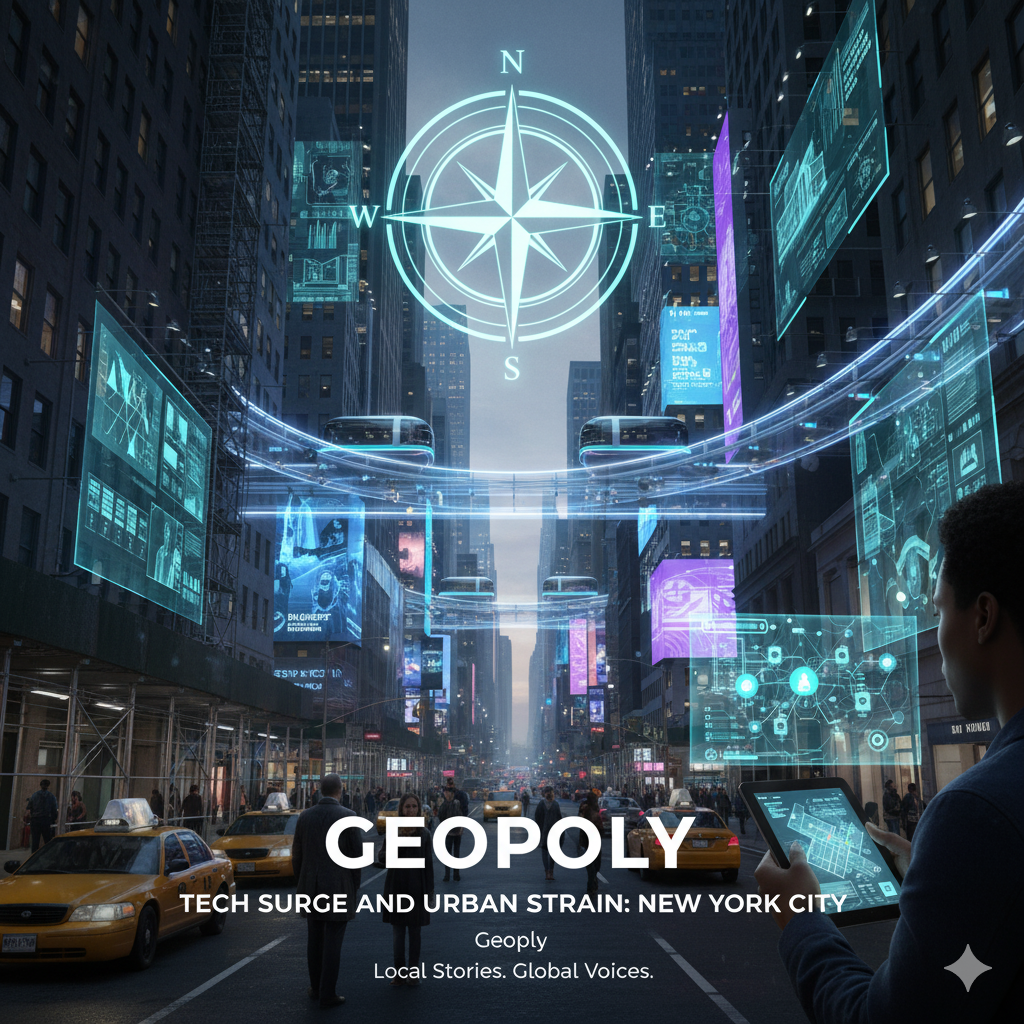

New York City is witnessing one of its most significant shifts — a tech-enabled surge that’s reshaping the urban fabric, infrastructure, and societal rhythms of the five boroughs. On the one hand, the city’s tech economy is booming. A recent report from the Center for an Urban Future revealed that the tech sector in New York is growing faster than almost any other major industry post-pandemic. NY1+2Center for an Urban Future (CUF)+2 On the other, the rapid growth is placing strain on housing, transit, and the lived experience of everyday New Yorkers.
Take commuting and infrastructure. The move to expand smart-city initiatives under the New York City Economic Development Corporation (NYCEDC) aims to embed tech-enabled transit solutions, sensors for public spaces, and sustainable upgrades across the city. NYCEDC+1 Yet these innovations must compete with legacy systems: subway delays, aging scaffolding, and crowded sidewalks. A recent study found thousands of long-standing scaffold permits unresolved, a signal of how infrastructure lag threatens both safety and revitalization. arXiv
Housing and affordability are also being tested. With many tech professionals relocating and the city courting new investment, neighborhoods are transforming—and not always for the benefit of longtime residents. According to a Business Insider piece, many in the NYC tech workforce now view the city through the lens of “abundance politics” – pushing for more housing, more transit, and more inclusive urban renewal. Business Insider The tension is real: How can New York remain a place for all its residents while it becomes a global tech magnet?
Culture and community feel the effect too. As new startup hubs emerge in Chelsea, Hudson Yards, and downtown Brooklyn, overlaying the long-established creative and immigrant-driven economies, questions arise around who gets to build the future—and who gets priced out of history. At the same time, urban planners see opportunity: the dense, mixed-use fabric of New York remains uniquely suited to innovation, not just in tech but in design, media, fashion, and public space.
For Geopoly readers, this means something concrete. If you live or work in New York, you’re part of the story: of the subway platform being upgraded with smart sensors, the coworking loft being re-imagined, the sidewalk café now sharing space with a drone-enabled delivery hub. Use Geopoly’s map-based interface to pin your story: Where did you see change? Where did you feel the squeeze of progress? We’re collecting narratives of a city in flux.